

The Machines Are Coaching Us Straight Into Servitude
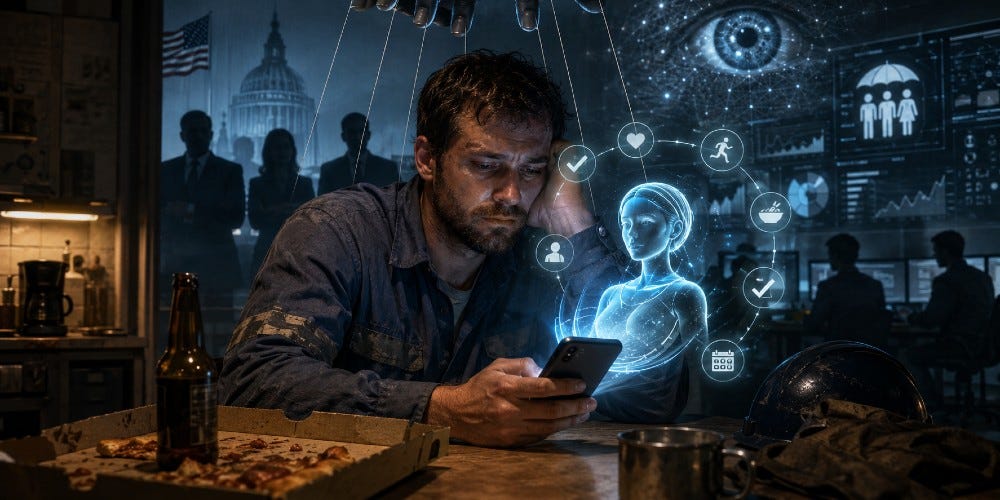
Picture the average man after a long shift. Tired. Hungry. Not in the mood for hard choices. He reaches for the phone, ready to order the greasy pizza and crack a beer.
Before he can finish the thought, an artificial intelligence life coach intervenes. Healthier dinner. Earlier bedtime. Maybe call a friend instead of scrolling. Over weeks the suggestions work. He sleeps better. He feels sharper. He becomes the more productive version of himself that every employer, insurer, and bureaucrat has always wanted.
It sounds like progress. It is not. It is the softest, most polite form of control ever invented, and Americans are walking into it with their eyes half shut.
Donald Kendal of the Heartland Institute recently laid out the danger with brutal clarity. The tools already exist. Google’s Fitbit AI health coach offers real-time guidance on sleep, exercise, and diet. BetterUp sells AI coaching to companies that want workers to communicate better and perform harder. Dozens of other systems are learning our schedules, finances, relationships, and weaknesses. They help us stick to goals we already claim to want. That part is not the problem.
The problem arrives the moment the machine stops helping us pursue our goals and starts deciding what those goals should be.
An employer’s AI will define “better” as more productive hours and fewer sick days. An insurance company’s AI will define it as lower medical claims and lower risk. A tech platform will define it as more time spent inside its ecosystem. A government will define it as behavior that is predictable, manageable, and quiet.
Each one can claim it is only helping. Each one is rewriting the meaning of a good life according to its own interests.
Who does the AI really work for? That is the question almost no one in Silicon Valley or Washington wants answered out loud. The man talking to the coach thinks it is his personal adviser. The system may be optimized for the corporation that pays for it or the regulator that certifies it.
Advice that begins as optional quickly becomes expensive to ignore. Lower premiums for the compliant. Higher rates or denied coverage for the stubborn. No formal order is ever given. The approved path simply becomes the only practical one.
The same logic is already climbing the ladder into public policy. AI systems now forecast economic shocks, political unrest, disease outbreaks, and the likely effects of legislation with accuracy that rivals elite human teams. Governments will use those forecasts. So will investors and military planners. Better predictions can produce better decisions. But a prediction is not a moral judgment.
An algorithm can tell a politician that mass surveillance would reduce crime or that silencing certain speech would calm the streets. It cannot tell him whether those outcomes are worth the cost in liberty. That calculation belongs to human beings who answer to voters and, ultimately, to God.
Political leaders are already treating the machines as oracles. Sweden’s prime minister admitted he regularly consults AI tools for a second opinion on governing questions. The United Arab Emirates has announced plans to place agentic AI systems in charge of half of its federal government operations within two years.
Once a president or governor is told that the model has identified the policy most likely to prevent recession or save lives, the political cost of rejecting the recommendation rises. Critics will ask why the official ignored the superior intelligence. The machine never has to issue a command. Its authority grows through the fear of being wrong without it.
Doctors will face the same pressure when they deviate from AI treatment protocols. Drivers will pay more for insurance if they refuse automated systems. Borrowers will struggle for credit after ignoring an AI risk score.
The formal decision remains human. The practical range of acceptable choices shrinks until the human becomes a rubber stamp.
This is not science fiction. A Heartland Institute/Rasmussen poll already found that 41 percent of likely voters aged 18 to 39 support giving an advanced AI system authority over the majority of public policy decisions. Thirty-six percent would let AI determine the rights of individuals and families, including speech, religion, and property. Thirty-five percent would hand it control of the world’s largest militaries. Among the youngest adults the numbers climb higher still.
Disillusionment with human institutions is real. Surrendering to silicon is not the cure. It is the final abdication.
As American Thinker has warned, technology without independent human judgment perfects systems of control rather than systems of liberty. AI does not grasp meaning, conscience, or the moral weight of a choice. It calculates. When a society begins outsourcing judgment itself, it slowly forgets how to exercise it.
Scripture is not silent on this. Joshua stood before Israel and declared, “And if it seem evil unto you to serve the LORD, choose you this day whom ye will serve.”
The call to choose is not a suggestion. It is the mark of creatures made in the image of a free God. We were given dominion, not designed to be managed by code. Handing the power of final decision to systems built by corporations and states is not efficiency. It is rebellion against the order of creation.
AI can show us the road ahead more clearly. That is a genuine gift. Human beings must remain free to choose which road to take, even when the machine insists another path would be more efficient, more healthy, or more profitable for someone else.
Transparency about who designed the system and whose interests it serves is non-negotiable. The right to reject the advice without punishment must be protected. Officials must never be allowed to hide behind the claim that “the computer recommended it.”
The quiet surrender of human agency does not arrive with jackboots. It arrives with helpful suggestions, lower premiums, and the promise of an easier life. Refuse the deal. The machine is not your friend. It is learning to rule you.
I have an old desktop computer and an old landline phone and my last car was older with no electronics. If the government wants to track me they can get a warrant. I do not enter act with machines that can control or make changes to my life [and I never use AI]. For the past fifty years I have been using desktop computers that have been crashing and burning and I will NEVER get in a moving vehicle run by one of these crash and burn machines. Machines cannot run themselves, they are either run by computers or they are demon possessed. There is God's Intelligence and there is Satan's artificial intelligence. What could possibly go wrong with that? I will not be finding out but if you want to use machines that your lawless government controls so they can control you... then go right ahead and use them. Personally I can't [(will not)] bend over that far.
Article's going-in premise fails. We're never told where the mysterious AI "life coach" comes from.
Did it just pop up as a "bubble" in front of the guy? Did it come from whatever device he's using to order "the greasy pizza"? Where?
And the implication is that whenever AI steps in, we have to pay attention and comply with its dictates. We don't - it's all optional.
Nice try, but no cigar.